


Brand impersonation detection is the process of identifying fake domains, cloned brand experiences, and exposure signals that show attackers are using a trusted brand to deceive customers, employees, or partners. For security teams, the harder problem is not finding every impersonation asset. It is knowing which signals indicate live user exposure and which ones should change the response.
That distinction matters because brand impersonation is no longer confined to fake emails or obvious typo domains. In 2025, consumers reported $2.1 billion in losses from scams that started on social media, according to FTC data published in April 2026. Reported losses were about eight times higher than in 2020, and many scam journeys began with ads that sent people to sites impersonating well-known brands.
APWG reported 3.8 million phishing attacks during 2025, with 853,244 attacks in Q4 alone. In that same quarter, the number of brands targeted by phishing campaigns rose from 457 in October to 496 in December.
The signal volume is not the real shortage. The real shortage is signal timing.
Most controls are optimized for the wrong stage of the problem. They identify impersonation assets for investigation and takedown, but they do not always show whether real users are already being exposed, whether credentials may have been harvested, or whether an account access attempt should now be treated differently.
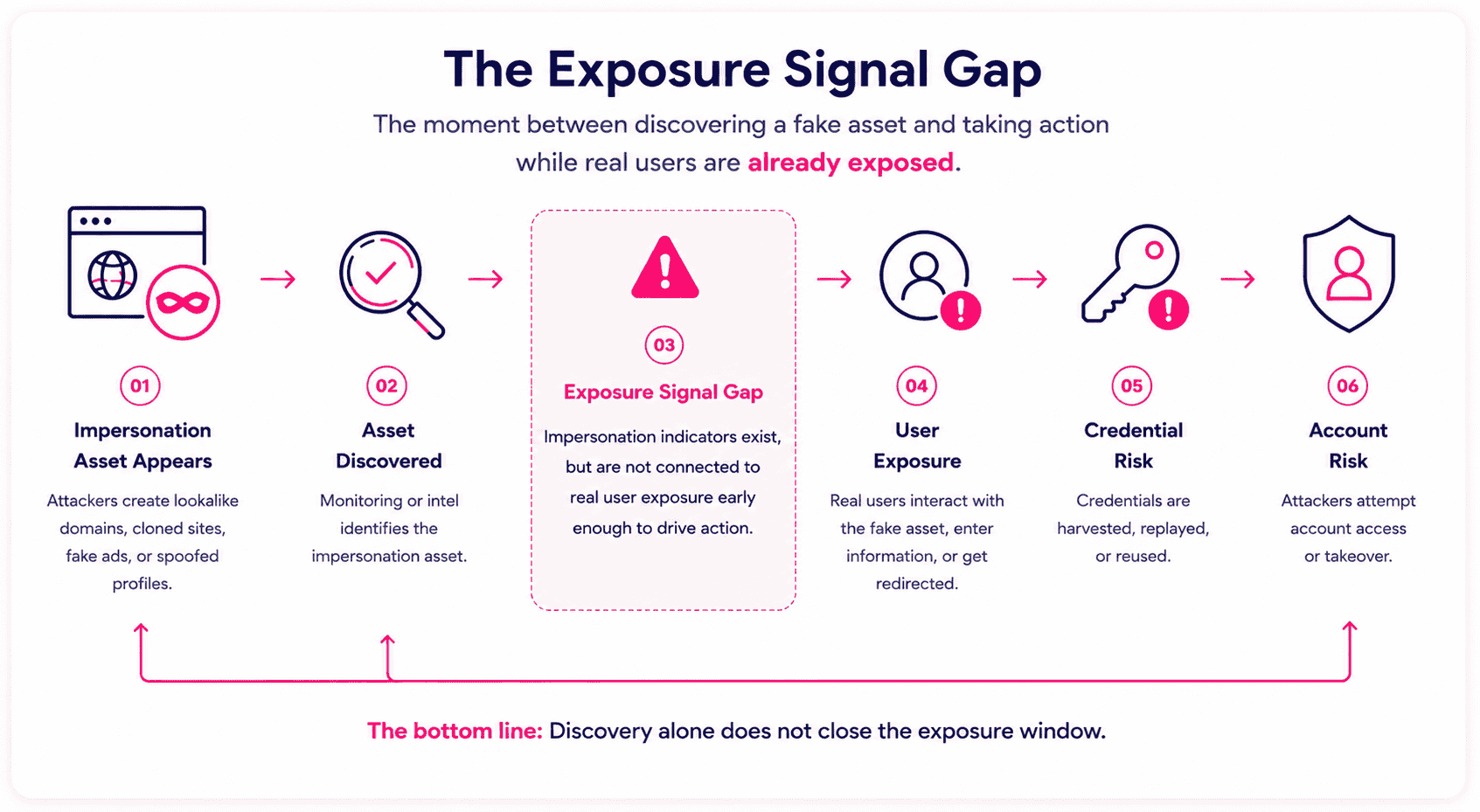
That is the Exposure Signal Gap: the moment when impersonation indicators exist, but are not connected to real user exposure early enough to change fraud response decisions.
TL;DR
Brand impersonation detection fails when teams treat fake-asset discovery as the finish line, rather than the start of exposure response.
The “Exposure Signal Gap” is the window where impersonation signals exist, but are not connected quickly enough to exposed users, credential risk, or account access decisions.
Lookalike domains, cloned websites, low-reputation referrals, decoy credential use, and suspicious login patterns all matter, but their value depends on when they are evaluated.
Traditional brand protection workflows often find impersonation assets for investigation and takedown, while fraud and SOC teams still lack visibility into who was exposed.
Domain takedown reduces external risk, but it does not automatically show whether users interacted with the fake asset or whether credentials are now being misused.
Closing the gap requires exposure-aware detection that connects impersonation indicators with user, credential, device, and account-risk context while the attack sequence is still active.
What is brand impersonation detection?
Brand impersonation detection identifies digital assets, traffic patterns, and authentication signals that suggest attackers are misusing a trusted brand to deceive users. These signals can include lookalike domains, cloned websites, fake ads, fraudulent profiles, suspicious hostnames, and login patterns that follow phishing exposure.
In enterprise environments, detection should not end with confirming that an impersonation asset exists. Stronger brand impersonation protection connects fake-asset signals with exposure, credential, device, and account-risk context.
Brand impersonation detection fails when exposure signals are treated as takedown evidence instead of live risk signals.
Why finding impersonation assets is not enough
Fake-asset discovery is necessary, but it is not the same as operational detection. A newly registered lookalike domain may be worth monitoring. A cloned login page may require takedown. A fake social ad may need platform reporting. But none of those actions automatically tells a fraud team which customers interacted with the impersonation asset or which login attempts deserve immediate attention.
This is where many brand protection programs break down.
External monitoring teams may find a fake domain. SOC teams may receive threat intelligence. Fraud teams may see account access attempts. Digital teams may hear from confused customers. Each workflow has part of the picture, but the risk is often evaluated in separate systems and at separate times.
The issue is not the absence of signals, but when those signals are evaluated.
If an impersonation asset is reviewed only after reporting, escalation, or takedown intake, the enterprise may be working with evidence that arrives after exposure has already occurred. That is why brand impersonation protection vs domain takedown should be treated as a question of operational control, not a vendor-category debate.
Attackers benefit from that delay because the impersonation page does not need to stay live for long. It only needs to stay live long enough to capture credentials, redirect a user, or trigger downstream account access.
Interisle’s 2025 Phishing Landscape report found that the total number of domain names used in phishing rose 38% year over year to more than 1.5 million. At that scale, treating every domain signal as an isolated takedown task creates an operational bottleneck. Security teams need a way to distinguish passive infrastructure risk from active exposure risk.
The Exposure Signal Gap: Where Signals Become Late Evidence
The Exposure Signal Gap appears when an organization can see pieces of an impersonation campaign but cannot connect them in time to change the outcome.
A security team may detect a lookalike domain. A brand team may find a fake page. A takedown provider may submit a request. But if the organization cannot tell whether real users reached the fake site, whether credentials were harvested, or whether the next login attempt is connected to that exposure, the response remains incomplete.
This gap is a timing problem and a control problem.
The timing problem is that many signals are evaluated after the user has already interacted with the impersonation asset. The control problem is that many detection workflows do not feed directly into the systems that decide whether a login, session, or account interaction should be challenged, blocked, or investigated.
For security teams, the important question is not simply whether a fake asset exists. It is whether that asset is part of an active sequence that may now affect users, credentials, devices, or accounts.
That is the difference between brand monitoring and brand impersonation detection.
Key brand impersonation detection signals security teams should evaluate
Effective brand impersonation detection depends on evaluating signals that show both impersonation-asset activity and active exposure. The most useful signals are the ones that connect timing, user context, and downstream account risk.
Key signals include:
- Lookalike domains and brand-like hostnames
- Website cloning attempt detection
- Traffic from low-reputation or impersonation-linked domains
- Developer tools reconnaissance detection
- Decoy credential use or credential replay indicators
- Suspicious login pattern detection after exposure

Lookalike domains and brand-like hostnames are often the earliest visible signs of impersonation infrastructure. They may include typo variants, misleading subdomains, SSL certificates tied to brand-like names, or domain patterns designed to look legitimate in search results, ads, messages, or social posts.
Website cloning attempt detection helps identify when attackers are trying to replicate a legitimate site experience. A strong phishing site detection and takedown solution should therefore help teams understand whether a fake page is part of a live attack path, not only whether it exists.
For phishing and credential harvesting scenarios, cloning matters because attackers often need users to believe they are interacting with the real brand at the exact moment credentials or payment details are entered.
Traffic from low-reputation or impersonation-linked domains can indicate that users are arriving at the legitimate site after interacting with an external source tied to phishing, spoofing, or brand abuse. This signal becomes more valuable when it is evaluated in sequence, especially when referral context aligns with credential entry, redirection, or account access attempts.
Developer tools reconnaissance detection can indicate that a visitor is inspecting a legitimate site to understand its structure, flows, or content. On its own, this condition may not prove malicious intent. In combination with cloning indicators, low-reputation referrals, or impersonation infrastructure, it can help security teams recognize preparation activity earlier in the sequence.
Decoy credential use or credential replay indicators are higher-confidence signals because they suggest that credentials entered in a phishing context are being reused against the legitimate site. This is where brand impersonation starts to cross into account takeover (ATO) risk.
Suspicious login pattern detection after exposure helps connect the impersonation phase to authentication risk. The value is not only that a login looks risky. The value is that the login can be evaluated in light of what happened before it.
Read more: Why website cloning attacks evade brand protection
Why timing changes the response
Timing determines whether brand impersonation detection supports investigation or intervention, because every attack creates a Window of Exposure between impersonation discovery, user exposure, credential risk, and effective response.
If a fake site is found after customers have already entered credentials, the organization is left with remediation tasks: takedown, password resets, customer support, fraud review, and incident investigation. Those actions still matter, but they are downstream actions.
If exposure is recognized while the impersonation sequence is active, security and fraud teams can act with better context. They can prioritize the asset, trigger user-facing or internal response workflows where appropriate, scrutinize related login attempts, enrich SOC or fraud workflows, and reduce the chance that harvested credentials become account access.
This is why the same signal can have different value at different times.
A lookalike domain discovered before distribution is a monitoring signal. A lookalike domain tied to user traffic is an exposure signal. A credential from that sequence appearing at login is an account-risk signal.
The detection model should change as the attack progresses.
Read more: Why brand impersonation protection can’t wait for the takedown
Brand impersonation vs phishing detection vs domain takedown
Brand impersonation detection sits inside the broader digital impersonation attacks category, but it is not identical to phishing detection or domain takedown. Brand impersonation focuses on misuse of trusted brand identity across domains, website spoofing, ads, profiles, messages, app listings, and other digital touchpoints. Phishing detection focuses more narrowly on attempts to steal credentials, payment data, or sensitive information. Domain takedown focuses on removing or disabling infrastructure after it has been identified.
The overlap is real, but the operating questions are different.
Brand impersonation asks: is our trusted identity being misused to deceive users?
Phishing detection asks: is this interaction designed to capture sensitive data?
Domain takedown asks: how do we remove or disrupt the offending asset?
Security teams need all three questions, but they should not confuse them. A takedown queue does not automatically provide exposure visibility. A phishing detector does not necessarily capture the broader brand abuse pattern. A brand monitoring alert does not always tell the authentication stack what to do next.
That distinction matters because attackers do not experience these categories separately. They move through them as one sequence.
Watch: Why outdated phishing protection misses live brand impersonation exposure, and how earlier visibility helps security teams respond before fake-site engagement becomes account risk.
What should security teams do differently?
Security teams should evaluate brand impersonation by sequence, not by artifact.
The common assumption is that the primary task is to find fake assets faster. That helps, but it does not solve the control problem. The stronger operating principle is to connect impersonation indicators to exposure, credential risk, and authentication decisions as early as possible.
The evaluation model should shift from asset discovery to exposure correlation.
A brand impersonation control is more useful when it can show how an external impersonation signal affects user, credential, device, or account risk. That means the core question is not only whether the system can find lookalike domains, cloned pages, or fake profiles. The stronger question is whether the system can connect those indicators to live exposure and move that context into SOC, fraud, and authentication workflows before takedown is complete.
This changes the operating principle for security teams: brand impersonation should be evaluated as a sequence of risk, not a queue of assets.
The friction point is simple: if your team finds the impersonation asset but cannot tell who was exposed, you are still missing the part of the attack that creates account risk.
That is the Exposure Signal Gap in practice.
Read more: How to calculate the ROI of brand protection software
How Memcyco helps close the Exposure Signal Gap
Memcyco helps enterprises detect and respond to brand impersonation by connecting fake-asset signals, exposure context, decoy credential use, and suspicious login patterns into a more actionable sequence.
Instead of treating impersonation only as an external takedown issue, Memcyco gives teams earlier visibility into conditions that may indicate active user exposure. These include spoofed domain detection, website cloning attempt detection, traffic from suspicious or low-reputation domains, detection of stolen or decoyed credentials in use, and login attempts that require closer evaluation after phishing exposure.
This helps security, fraud, and SOC teams work from a shared risk picture. Security teams can understand when impersonation activity is active. Fraud teams can evaluate account access attempts with better context. SOC teams can prioritize incidents based on exposure and credential risk rather than asset discovery alone. Operationally, this means a brand impersonation signal can move from an external monitoring alert into a fraud, SOC, or authentication decision while the attack sequence is still active.
Memcyco does not replace takedown, phishing analysis, or fraud investigation. It strengthens the timing and context around them.Brand impersonation detection is stronger when exposure signals are evaluated before they become downstream account incidents.
FAQ
What is brand impersonation detection?
Brand impersonation detection identifies signals that attackers are misusing a trusted brand to deceive users. These signals may include lookalike domains, cloned websites, fake ads, spoofed profiles, low-reputation referrals, and credential-use patterns connected to impersonation exposure.
What are the strongest signals of brand impersonation attacks?
The strongest signals combine impersonation-asset evidence with exposure or account-risk context. Examples include lookalike domains tied to live traffic, website cloning attempts, suspicious hostnames, low-reputation referral paths, decoy credential use, and login patterns that follow phishing exposure.
How is brand impersonation detection different from domain takedown?
Domain takedown focuses on removing or disrupting an offending asset after it is found. Brand impersonation detection focuses on identifying the attack sequence, including fake infrastructure, user exposure, credential risk, and downstream account access conditions.
Why does timing matter in brand impersonation protection?
Timing matters because an impersonation asset may capture credentials before takedown is completed. Earlier detection enables teams to prioritize exposed users, evaluate related login attempts, and reduce the window in which impersonation activity can turn into account takeover risk.
What should buyers look for in a brand impersonation detection solution?
Buyers should look for more than asset discovery. A stronger solution should connect impersonation-asset indicators with exposure context, credential misuse signals, and workflows used by SOC, fraud, and risk teams.
Close the Gap Between Impersonation Exposure and Response, with Memcyco
Brand impersonation protection should be measured by how effectively it reduces risk during the full attack sequence.
Domain takedown remains necessary because fake assets need to be removed. But removal alone does not answer whether customers were exposed, whether credentials were harvested, or whether later legitimate-site activity should be treated with additional context.
If your brand impersonation program is measured only by takedown speed, it may be optimizing for the moment after exposure has already begun.
During that gap, customers may interact with fake journeys, submit credentials, or return to your legitimate site with risk context your teams cannot see.
Memcyco helps security and fraud teams close the Exposure Control Gap by surfacing active impersonation exposure, identifying affected users, and enabling earlier action before brand impersonation escalates into account takeover.
Book your product tour and discover how Memcyco helps security and fraud teams close the Exposure Control Gap by surfacing active impersonation exposure, identifying affected users, and enabling earlier action before brand impersonation escalates into account takeover.

Eran Tsur is CEO of Memcyco. He writes about the growing impact of digital impersonation, phishing, and account takeover attacks on global enterprises. His insights focus on how organizations can move beyond traditional fraud detection and adopt earlier detection strategies to stop impersonation-driven attacks before customer accounts and brand trust are compromised.


