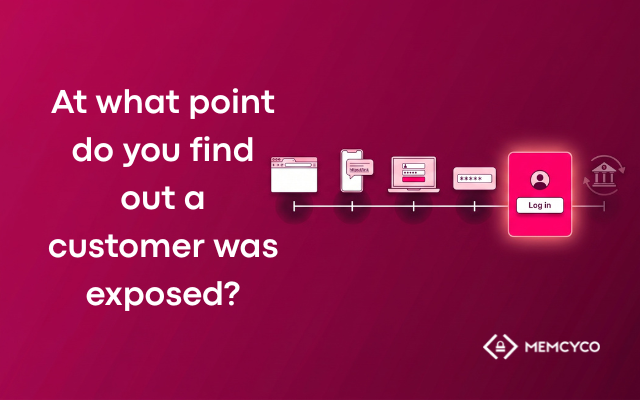
At what point do you find out that one of your customers has been exposed?
Ask a head of fraud that question and wait. In the rooms I have sat in since joining Memcyco, the answer comes back the same way, sometimes with a laugh.
Too late.
That answer is a design choice. Most fraud stacks are built to find out at the login, or after the money moves, because those are the two places the stack has tools. The exposure happened earlier, somewhere the stack has no tool at all.
Two stacks and the space between them
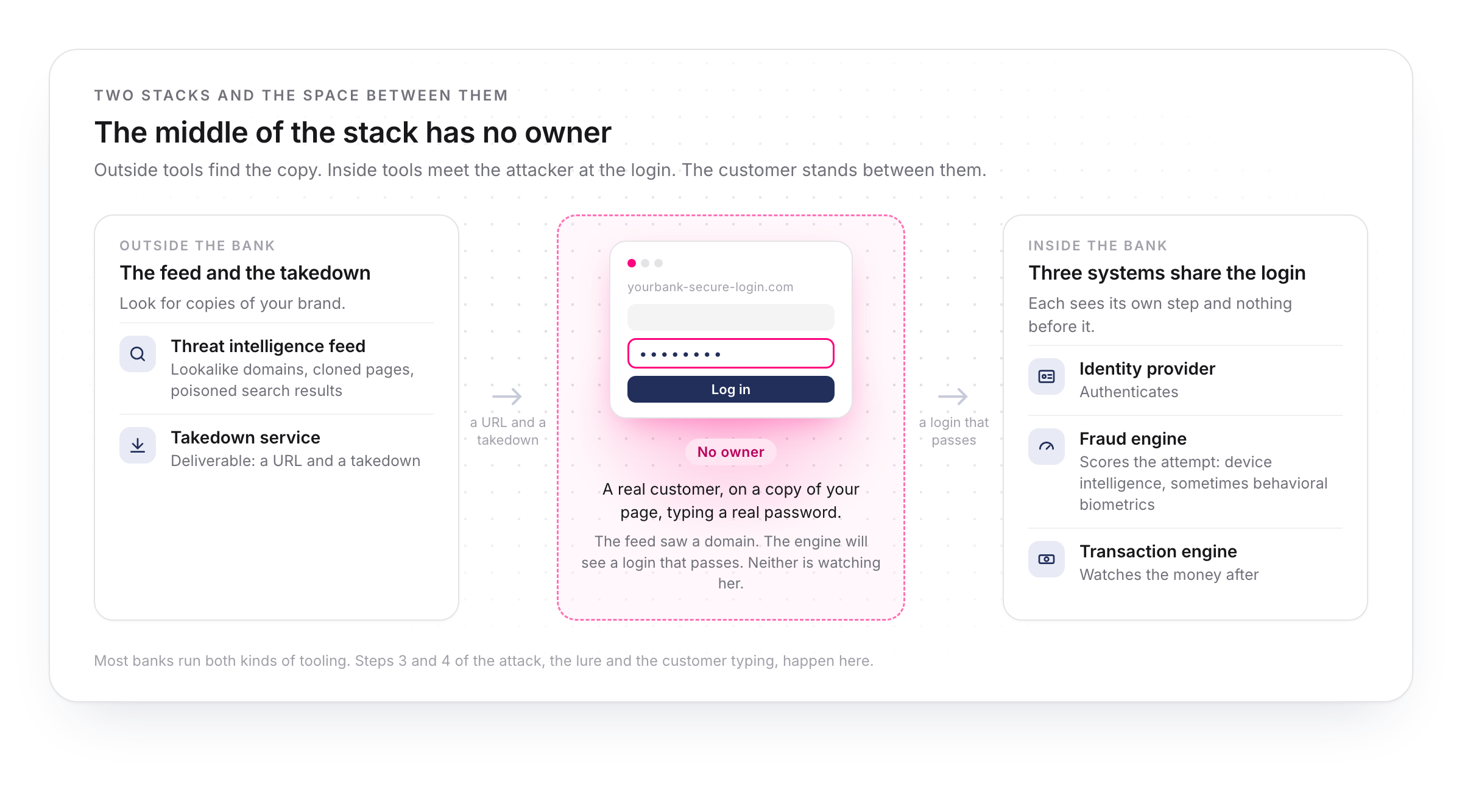
Most banks run two kinds of fraud tooling.
Outside, a threat intelligence feed and a takedown service look for copies of your brand: the lookalike domain, the cloned login page, the poisoned search result. Their deliverable is a URL and a takedown.
Inside, three systems share the login. An identity provider authenticates. A fraud engine scores the attempt, usually with device intelligence and sometimes with behavioral biometrics. A transaction engine watches the money after. Each one sees its own step and nothing before it.
Between the outside tools and the inside tools is a customer. She got a text, tapped a link, landed on a copy of your login page, and typed her real password. The feed saw a domain. The engine will see a login that passes. Neither was watching her.
That is the middle of the stack. In most stacks it has no owner.
Four things happen before the login
Fraud has a supply chain. The attack is formed, distributed, engaged with, harvested and then exploited, in that order, and the login sits at the last link. Here is that chain for a copied-page attack, step by step, with the control that sees each step today. Run your own stack down the right-hand column.
| Step | What happens | Who sees it today |
|---|---|---|
| 1. Reconnaissance and cloning | Your login page is copied; the kit is assembled | No control in the stack; the feed arrives at step 2 |
| 2. Domain, certificate, hosting | The copy goes live | The feed, often from certificate transparency logs, then the takedown service |
| 3. The lure | A text, an email, a poisoned search result, a fake support call | No control in the stack; it happens on the customer’s device, outside the bank |
| 4. The customer arrives and types | Real customer, real password, a copy of your page or a live relay of it | No control built for it; on a live relay your device and behavioral tools see a session, and the stack meets the result at step 5 |
| 5. The password is used | Within minutes when an operator is live; days later when the harvest is sold | The fraud engine, as a login that passed, with or without a new device |
| 6. Money moves | Transfer, beneficiary change, loyalty drain | The transaction engine, then the dispute, then the call center |
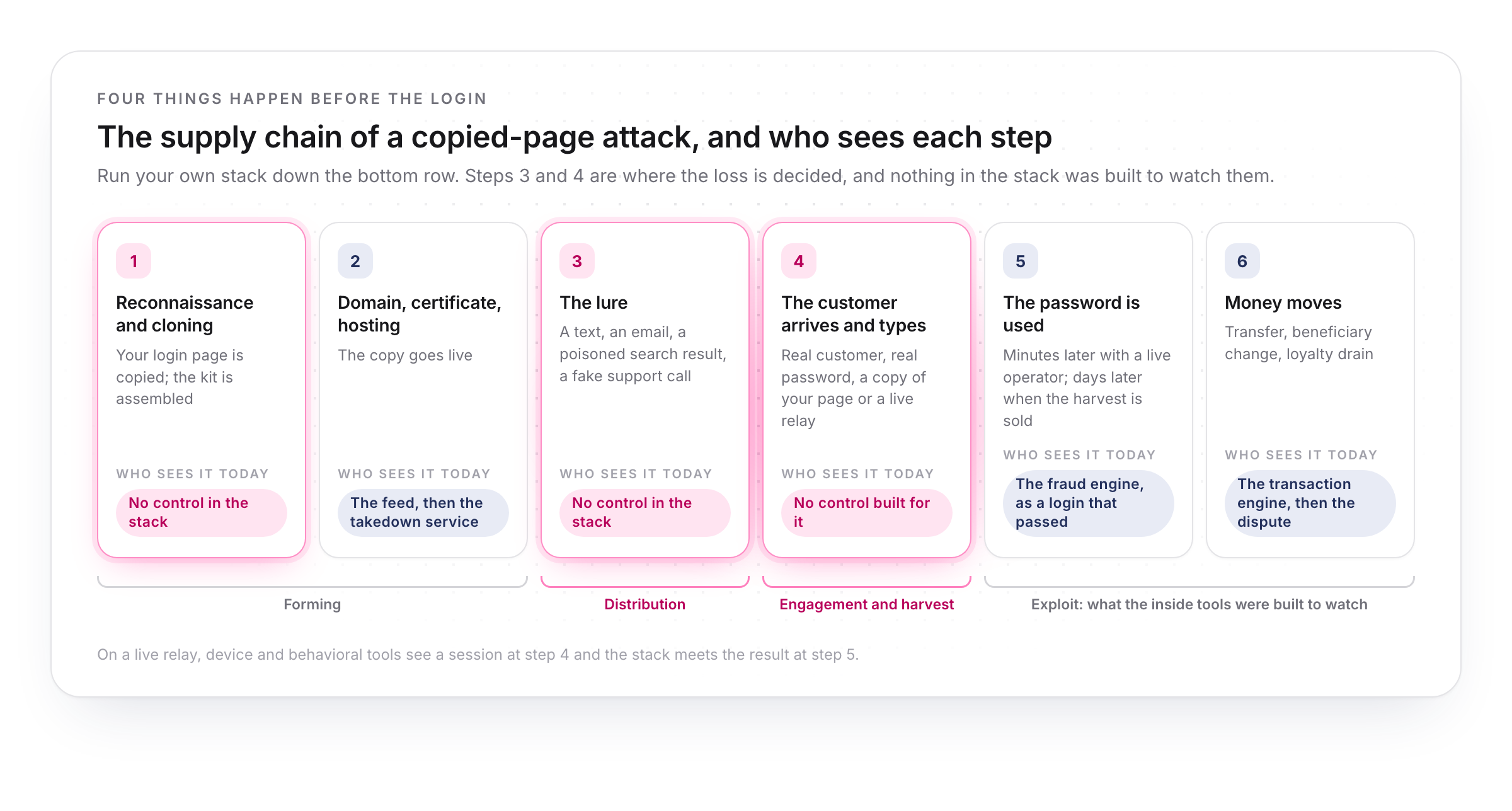
Steps 1 and 2 are the forming. Step 3 is the distribution. Step 4 is the engagement and the harvest, in the same moment. Steps 5 and 6 are the exploit, the two steps the inside tools were built to watch. The feed watches step 2. Steps 3 and 4 have no control in the stack.
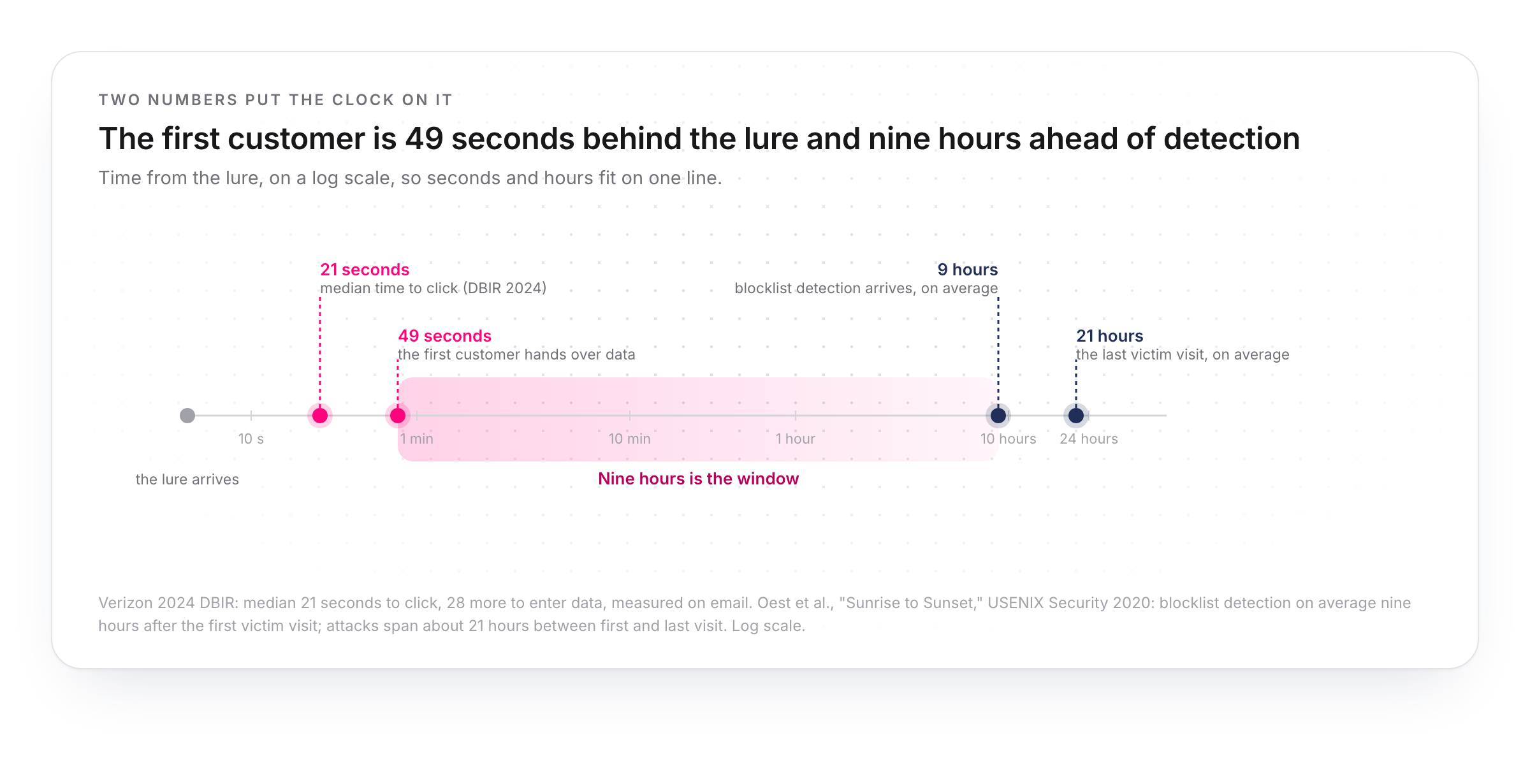
Two numbers put the clock on it. Oest and colleagues, in the “Sunrise to Sunset” study presented at USENIX Security in 2020, found that the average phishing attack spans about 21 hours between its first and last victim visit, and that blocklist detection arrives on average nine hours after the first victim. Verizon’s 2024 Data Breach Investigations Report puts the median time for an email recipient to click a phishing link at 21 seconds, and the time to hand over data at 49 seconds in total, measured on email.
So the first customer is 49 seconds behind the lure and nine hours ahead of blocklist detection. Steps 3 and 4 are where the loss is decided, and nothing in the stack was built to watch them.
Nine hours is the window.
The cost of finding out late runs well past the fraud loss: the reimbursement, the chargeback, the dispute, the call-center surge, the takedown fee, the legal exposure, and the customer who was made whole and moved their primary account anyway. Analysts triage alerts from tools that did not see the attack or the victim. Teams grow with attack volume. Together that is the total cost of fraud, and it is the number the budget is funding against.
Why more of the same does not close it
More feeds find the URL faster. A URL is still not a customer. The feed sees the asset once it surfaces, not who arrived on it, whether they entered credentials, or which of your accounts to worry about tonight.
Stronger authentication makes the login harder to pass. It does nothing for the customer who passes it for the attacker, on a copy of the page or by reading a one-time code to a caller who says they are from the bank.
More scoring at the login is inference at the last possible step. Device intelligence narrows the inference, and it was built to read the device in front of it, not where the password came from. By the time the engine scores a new device, every step before it is done, and the engine is inferring whether a passed login was the customer on a new phone or an attacker with her password. Score it hard and the false-positive bill arrives. Score it soft and the attacker does.
Regulators and liability are both moving while this plays out. In the US, the FFIEC’s 2021 authentication guidance, carried as OCC Bulletin 2021-36, calls for layered security and names single-factor authentication as a weakness. In the UK, mandatory reimbursement for authorized push payment fraud has been live since October 7, 2024, split evenly between sending and receiving firm and capped at £85,000 per claim; the Payment Systems Regulator reports £243 million reimbursed by the end of 2025. The EU’s Payment Services Regulation, not yet in force, will add a narrower version: a full refund where the fraudster impersonated the customer’s own bank. Canada’s proposed consumer-fraud rules for banks, pre-published in the Canada Gazette on June 27, 2026, are written to come into force on July 1, 2027, with no reimbursement mandate.
None of the four is written around the copied login page. The UK and EU rules raise a bank’s cost when a scam began on one; the US guidance and the Canadian proposal raise what a regulator expects to see in place before it did.
Here’s the thing. The question the stack was built to answer is “did this login pass?” The question that decides the loss is “was this customer exposed before they got here?”
The question that changes the design
The second question is harder, and it is the one I would take into the next fraud review: if you knew this customer was exposed before they logged in or paid, what would you do differently for them?
One distinction makes the question answerable. A risk score is an inference about an attempt. An exposure is an observation about a customer: she went to the copy or she did not, she entered credentials or she did not. The engine observes the attempt on your page and infers what happened before it. A layer in the middle observes the before.
The useful answers are design changes at points the bank owns today. The exposure answer fits a decision the bank already makes, with no new workflow around it. Each row below is a decision most banks take on a risk score; the right-hand column is what an observed exposure adds to it.
| Point in the journey | What the exposure answer adds |
|---|---|
| Login | An observed exposure behind the step-up decision, added to the score inferred from the attempt |
| MFA or passkey enrollment and re-enrollment | Stronger proof when the user or device carries observed exposure, before the attacker’s device has any history |
| Password reset and account recovery | A step-up, or a hold, on the reset for a customer seen on a copy of your page this week |
| Device registration | Declining a device tied to a specific attack, or seen replaying a marked credential, before it has fraud history |
| Beneficiary change and payment approval | The account’s prior exposure weighed in a decision you already make, with the transaction score untouched |
No new queue.
Two details decide whether the answer is usable. Visited and typed are different facts: a customer who landed on the copy and left is a watch item, and a customer who entered credentials is an action item. And exposure ages: this week’s answer means more at tonight’s login than last quarter’s. Ask for both before you ask for the feed.
The design rule that makes this workable is restraint. One answer at the moment it is asked, not another stream of alerts for the queue. What a fraud team needs is the names of the customers who stood on a copy of its page, at the login, the reset or the payment, in time to act. The list of sites can stay with the feed.
What a layer in the middle is not
Any claim about the middle of the stack should come with its limits attached, so here are the ones that matter.
It does not replace MFA, behavioral biometrics, the fraud engine, the identity provider or the takedown service. Each of those still owns its step and its decision. The middle layer tells them something earlier.
Transaction monitoring and session analytics stay with the tools built for them. This layer does neither.
It does not reach a scam that lives entirely on a phone call, with no copied page and no remote session. A customer talked into sending money to a “safe account” with no screen involved is outside this layer.
A live relay that proxies your real page gets no decoy from this layer. Those sessions can be identified from browser, session and device signals, in supported paths, and that is the limit. The native app is the same: the layer sees the web login, and a vendor should say which paths are supported before you ask.
If a middle layer cannot name those limits, it is not a middle layer.
Where Memcyco sits
Memcyco watches the steps between the feed and the login, outside your environment, where the copy forms and your customer meets it. One script on your login page, live in days, not months, with nothing on the customer’s device. On supported copies of the page we can see the copy forming and your customer arrive, and whether they entered credentials, and we name that customer, not the URL, while the site is still up. On a supported fake form, what the attacker captures is a marked decoy: the stolen password is useless to them, and when the decoy is tried on your real login the attempt can be recognized and tied to the attack. The device that tried it is known from then on. Each piece of that is an observation, not an inference: this customer, this scam, this device, this time. It reaches your fraud, identity or SOC workflow as an alert, or as the answer to an API call at whichever point in the table above you choose to ask, and your control does what your policy says.
Enhancement, not replacement.
The two questions a CISO asks first are which attack paths are supported and what the proof looks like on your own brand. We answer both starting with a count of the live attacks against your brand this month, before anything is installed.
Login controls were built as the last line of defense. Somewhere along the way they became the first line of visibility too, and that second job was not theirs to carry.